Taishan: 9/25-26/2007
China
[ Please read the intro to Taoist Mtns in China if you have not already ]
From the city of 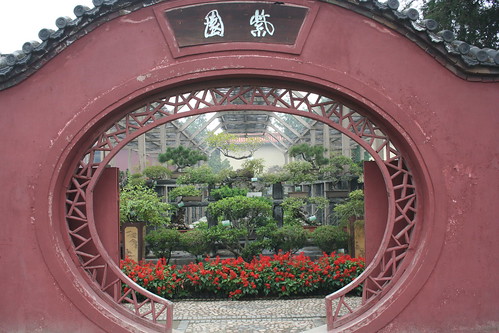
The morning of our ascent of Taishan, we went to breakfast at the hotel's buffet, but we limited ourselves to steamed buns and hot milk because other choices included insect cocoons in chili sauce, and pan fried scorpions... yikes! Interestingly, in 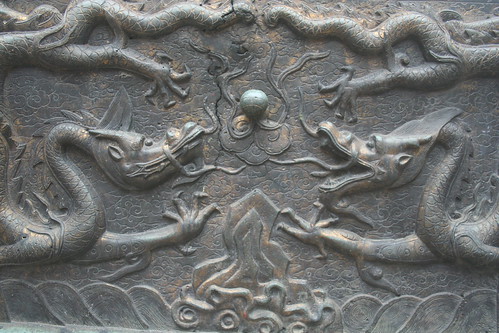
When the taxi dropped us off at the trailhead (the First Gate of Heaven), we walked with eyes popping at all the souvenir and prayer stands, up to the Guandi Temple (Guandi is the Taoist god of war). It is crowded and smoky, but also more mystical than anything we have seen in China so far. As we continue up the canyon, the rock walls and boulders are covered with calligraphic art dating from who knows how far back; all sorts of prayers and poems. It is like an outdoor Chinese calligraphy museum. 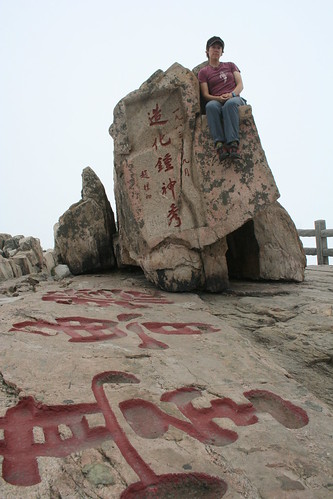
The mountain Taishan is deeply rooted in China's most ancient creation myth, the story of Pan Gu. In the beginning, all was chaos. Heaven and earth were swirling together. Pan Gu was born and started to separate the ground and the sky. Each day he grew taller; thus the sky grew higher and the earth grew thicker. After 18,000 years, the earth and sky were fully separated and Pan Gu died of exhaustion. His eyes became the sun and moon, his blood became the rivers, his sweat the rain. His head and limbs became five sacred peaks... Taishan is his head. 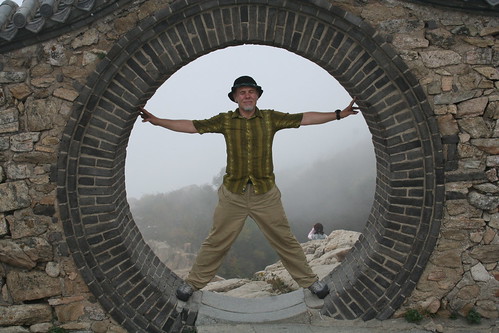
His head is 7.5 km of endless stone stairs. It is said that 6660 steps lead up to the Midway Gate to Heaven, but I didn't count. 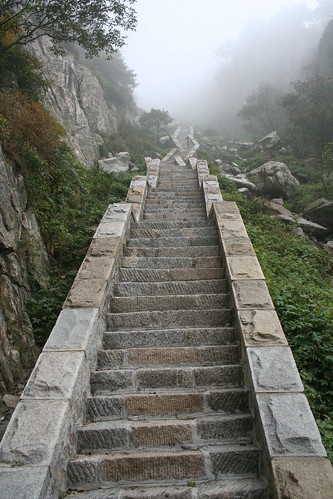 The climb is hot and uncomfortably sweaty. And, as we soon began to expect in China, it was stinky and very crowded with people. People who were extremely loud (you really wouldn't believe it), and often seen/heard hacking phlegm and spitting it anywhere.
Only 5 of China's emperors ever climbed Tai Shan, although Emperor Qianlong of the Qing dynasty scaled it 11 times. (note- climbing it for an emperor means riding in a sedan chair up and having resting houses built for you as you go. ) Legend has it that when Confucius was on the summit he uttered the dictum "The world is small." And when Chairman Mao lumbered up, he declared "The east is Red."
Along the way we visited and past many temples and shrines. Many of these were dedicated to the goddess Bixia, the Princess of the Azure Clouds. She is a powerful cult figure for the rural women of Shandong and beyond. We saw many little packs of grandmothers (it is said that if you climb Taishan, you will live to be 100) stumping their way up, stopping to pray at the shrines, and eagerly heading to the cluster of temples at the summit where they burn money and incense, praying for their progeny.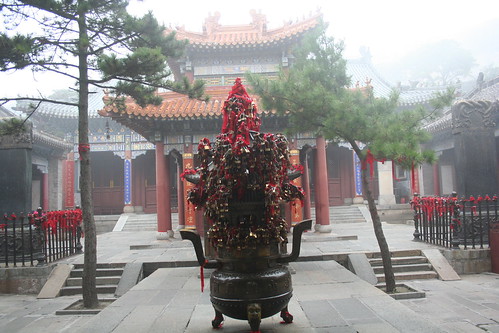
To reach the summit area, Rod and I walked hand in hand through the Archway to Immortality. We took the lock we carried up and put in onto the chain of locks at the temple there. By this time a thick mist had begun to gather. 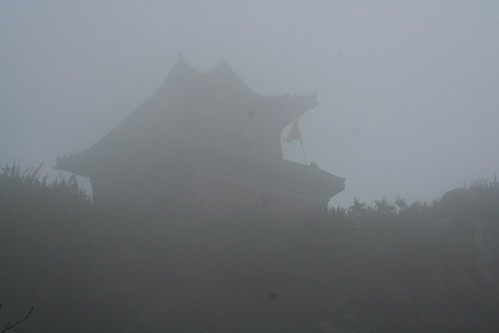 We passed through the South Gate to Heaven on our way to visit the Azure Clouds Temple, then followed an uncrowded, longer path up to the Jade Emperor Temple (1545m). Having a little isolation allowed our imaginations to peer through the mist and see the true nature of this ancient sacred summit.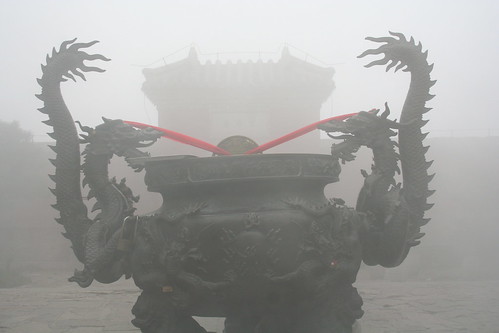
The Jade Emperor Temple is the place where Imperial sacrifices to heaven and earth were offered (don't know what was sacrificed... animals probably... and people?). 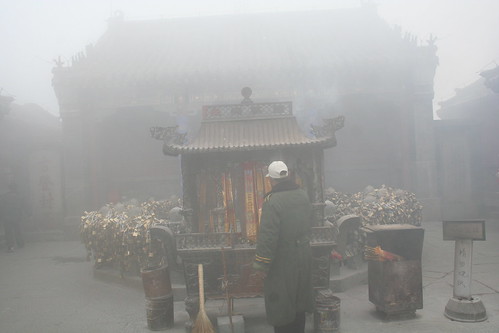 Along the stone pathway to it, the steep cliffs dropped off into the mist below us, the deciduous trees were beginning to show orange and red, and the smell of wild flowering marijuana filled our noses. After visiting the temple, we sat on the rocks outside and made our offering to Bixia. After some rest and people watching, we walked back down to the Archway to Immortality. There we got a yummy snack of thin flat bread, spread with plum sauce, and wrapped around a green onion, before heading to the cable car (!) to ride down through the clouds.


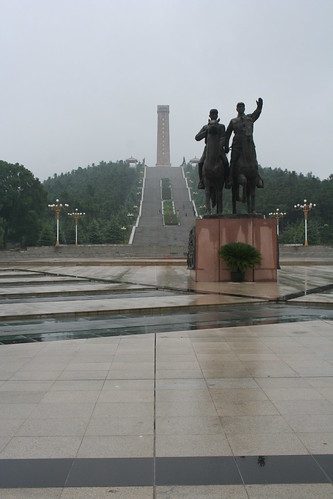 As we climbed up, the police/military men who sold us the tickets to see the memorial set off a racket of fireworks at the bottom. After this strange and somewhat disturbing visit, the taxi driver took us on to the real Maoshan starting point, a temple on the opposite side of the mountain.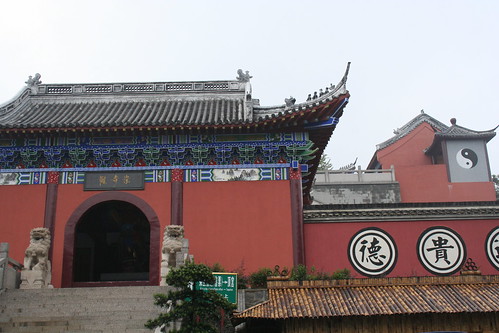
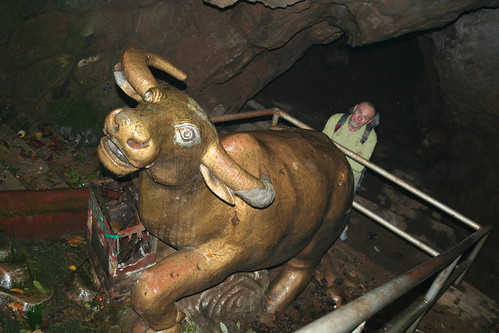 Whatever had been the 8th world of caves was now more like the "It's a small world after all" ride. We headed back up to the main trail.
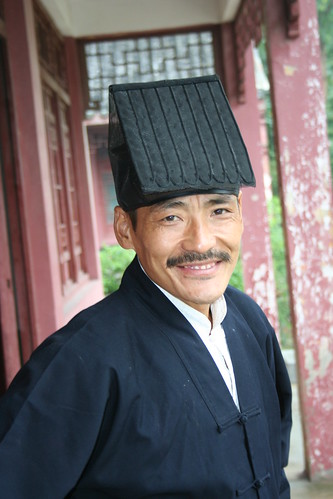 A monk greeted us at the door, and led us in to where we bowed as he struck a musical bowl. Then he walked us through the building to some beautiful gardens and pond where the trail to the summit continued.
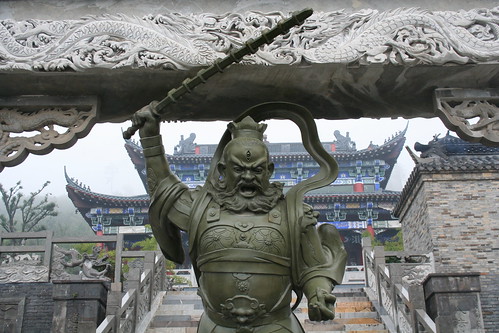 We walked through and up a long set of stairs to another temple, stopping to examine a set of sculptures; the animals of the Chinese zodiac. At this temple, a group of Taoist monks were playing traditional music and singing.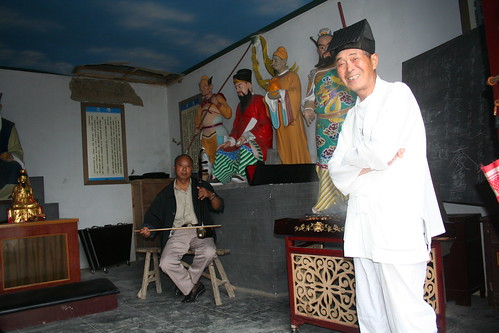
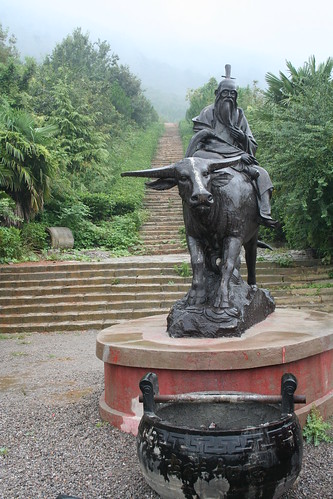 It was interrupted by a newly built, and horrible, wax museum of various forms of torture and demons. We practically ran through it to get to the trail again. The stone steps became wooden planks on wobbly chains until we arrived at a small pagoda. Here two people were playing cards and smoking cigarettes and selling small heart shaped locks for couples or family to lock onto the chains. We bought one, engraved "R+S", and locked it on.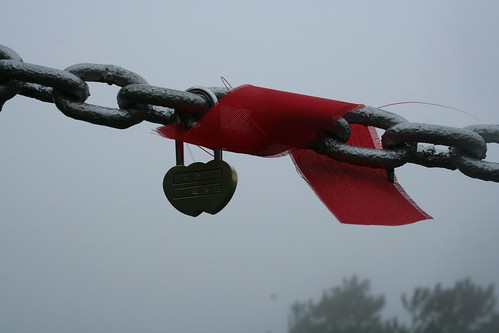
 a great bell, and a sematary, among other things, and along the path up are many shrines and standing stones.
 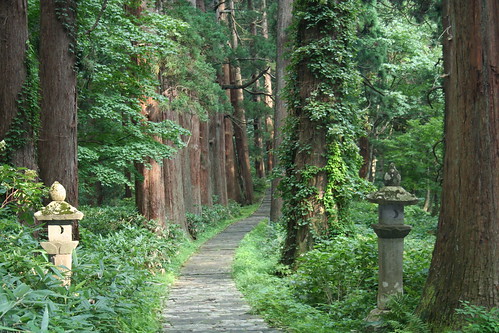 On the top is the shrine of Gassai-den which houses the deities of the tree mountains: Tsukiyomi-no-Mikoto, Oyamatsumi-no-Mikoto, and Ideha-no-Mikoto. The deity of Yudono lives, not in a building, but in a hot water fall. Pilgrims take off their shoes and bathe in the sacred water.
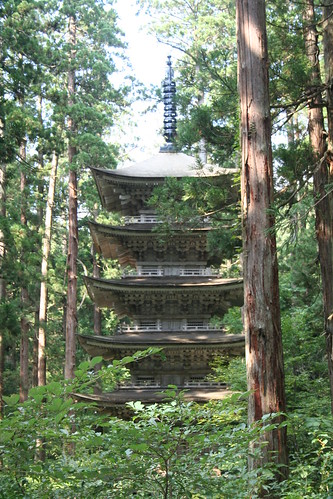
 Soon we came to the Go-Jyu-No-To, a wooden five-storied pagoda built in 931 to 937 AD.
  Starting to get used to the idea of climbing stairs (so many more to go!), we kept moving through the forest. We (well, I, really) couldn't help but take a short detour to visit the Minami-Dani (southern valley), the site of a temple built in 1662. Here, the famous haiku poet, Matsuo Basho, stayed while climbing Haguro-san and wrote several haiku. About Minami-Dani, he wrote:
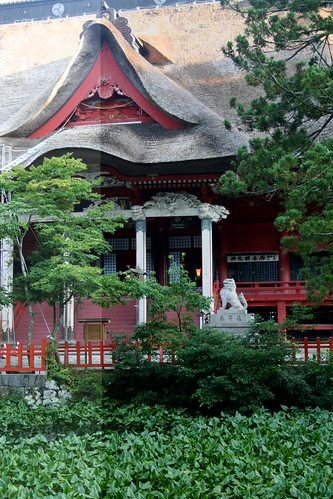 It is a magnificent structure; the 2.1m thick thatched roof supported by a wooden structure is one of a kind. Also on the summit is a monastery, the Kotakuji Temple, a huge bell (from 1275), various other structures, and a very interesting graveyard.
 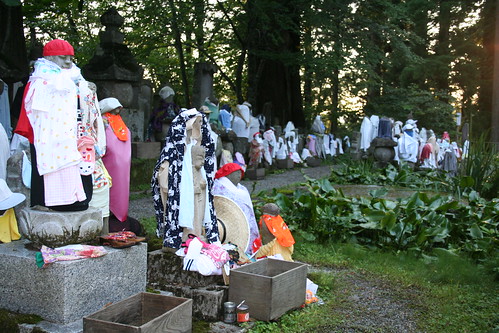 We explored the summit area before walking down a bit to our lodging, the Saikan.
 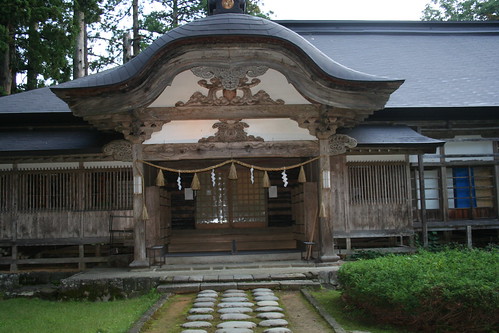 This building used to be a temple called Kozoin, where priests held divine service. Now it is used to provide pilgrims to Dewa Sanzan with accommodation and meals. We were shown our room, a simple grass mat floor room with a low table for tea, and two futon mats on the floor.
 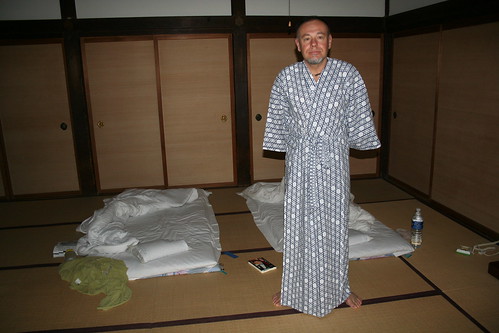 Our meals there were great, we sat on the floor and were served traditional Japanese food on low tables by the monks who lived there.
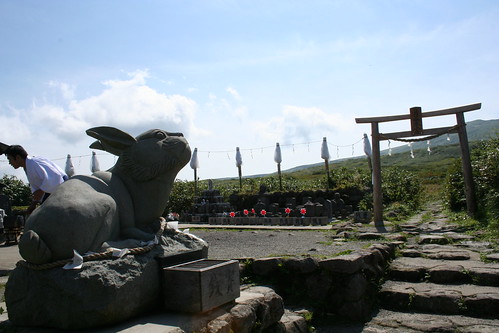 This hike is not stairs, it is a beautiful trail through brush, scattered with peaceful ponds. At the summit is the Gas-san Jinja shrine.
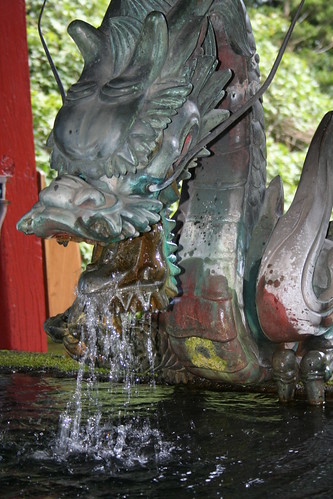
 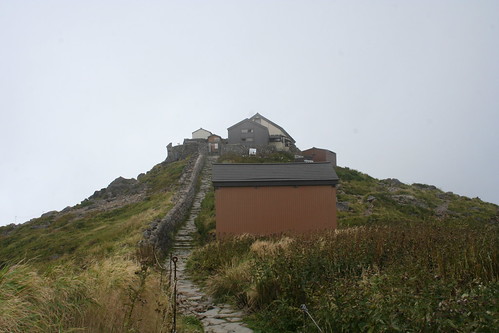 To enter the shrine we had to be purified. We had to bow our heads before the Priest for a blessing, then rub our shoulders, arms, body, legs and feet with sacred paper. Then we dropped the paper in a fountain. We visited the shrine in a foggy mist, then continued down the other side of the mountain toward Yudono-san.
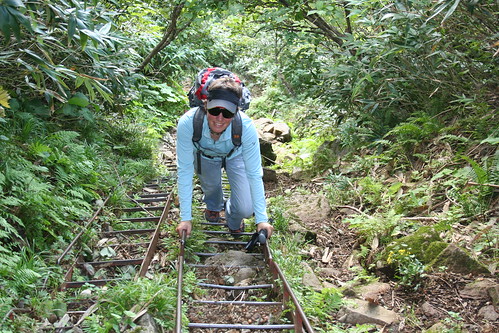 Again here, i was blessed and purified with sacred paper, then instructed to take my shoes off and follow the priest through the shrine. In front of me was a huge orange rock with a hot (and i mean HOT) spring bubbling from pools at it's top. The whole rock was continuously lapped by water from the spring. I am guessing that the rock was formed from precipitates as the hot mineral water bubbled up and over. The rock itself is said to be an embodied deity. The monk told me to walk, clockwise, up the side of the rock, over it's top and back down. The hot water burned my feet as i walked the circle and tried not to slip. At the bottom, the monk rinsed my feet with more of the water, then let me out. Yudono-san Jinja has the strictest rituals of the three mountains.
 -------
 We treated ourselves to a night in the Hyatt hotel and watched the trees blow and tear, the water gust in sheets across the streets below, from a room in the 27th floor. It was very cool!
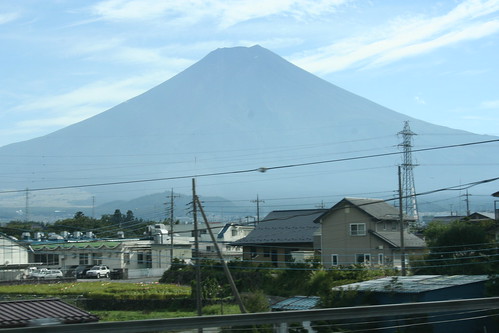
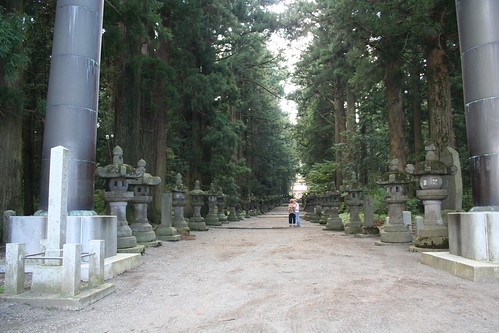 to the Sengen-jinja shrine. It is traditional to climb Fuji-san from the bottom, at the Sengen-jinja shrine, and up the Yoshidaguchi trail.
 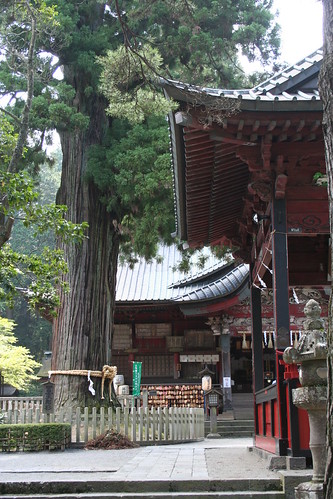 We paid homage to the gods at the shrine, then began the 19 km assent.
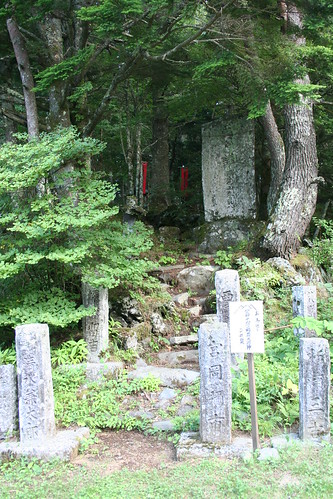
 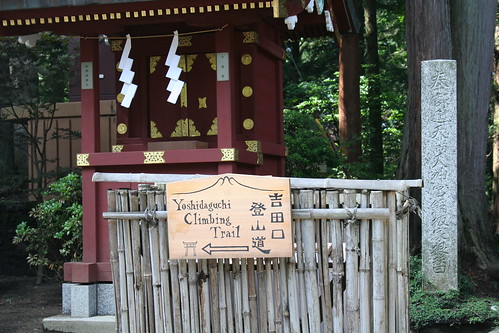 Yoshidaguchi trail is the oldest path up the mountain. We passed through lush forests that we had almost entirely to ourselves (most people take the bus to the Kawaguchi-ko 5th station, and start there) . We passed Nakanochaya, an ancient site marked by carved stones left by previous climbers/pilgrims.
  We walked through the Torii, with monkeys on either side, that marks the formal entrance to the sacred area of the mountain.
  Then past the 1st, 2nd, and 3rd stations to the Nyonin Tenjo (women's holy ground) which until 1832 was as far up as women were allowed to go. On we went until we arrived at the 5th station hut on the Yoshidaguchi trail (2305 m). We had reserved space in the hut, so when we arrived, we were warmly greeted, shown our bed space, then washed up before being served dinner.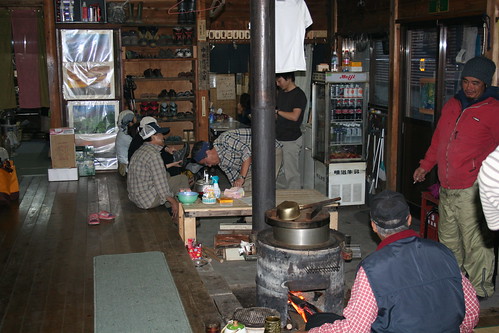
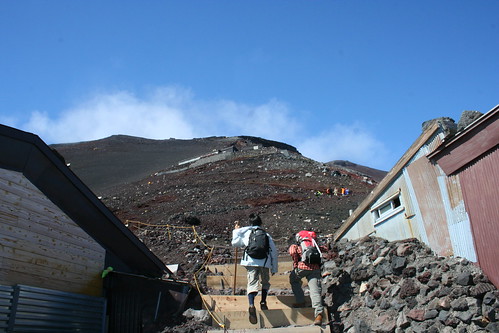 We got a bit confused as to which of the seemingly continuous string of buildings, cafes, and hotels, was officially which station.
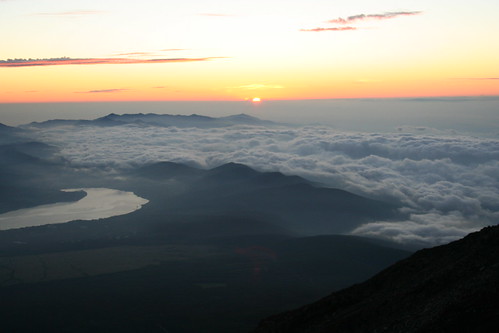 Later, as our trail started to fill with other climbers, we noticed the decent trail absolutely crowed with climbers who were at the summit for sunrise.
 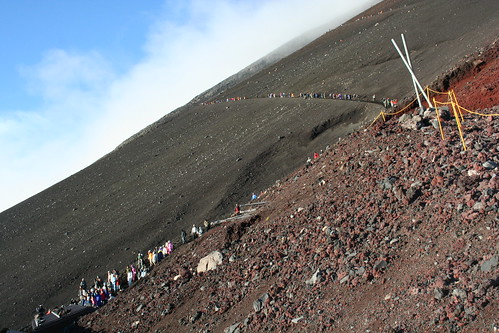 Around the same time, a thick fog began to accumulate around the summit. When we walked under a small Torii,
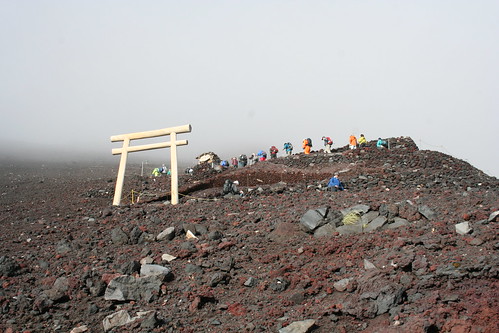 and up to a plateau with cafes selling hot tea, we thought we were at station 8. We took a rest, put on our cold weather gear (we were inside a cold blowing cloud by this time), and asked a group of climbers where the trail continuing to the summit was. They said "this IS the summit!" (oops- we didn't even know that we made it to the top :}) . It took 3.5 hours to climb the 1500 m from 5th station.
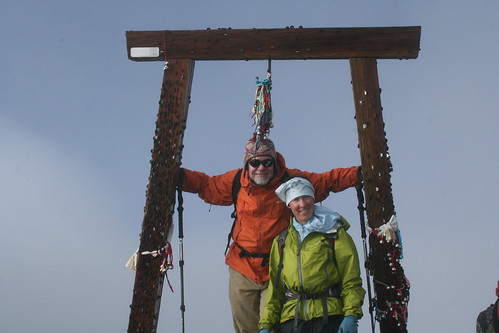 We then continued on, to circumnavigate the summit cone ridge clockwise. We stopped at the weather station, which is the true highest point (3776m/12,388ft), and continued to a nice rounded open area were we paused to rest and reflect.