Sunday, June 17, 2007

Mt Kilimanjaro

Mt Kilimanjaro: 6/17-22/07
Tanzania

Summer Solstice

"Summer Solstice is active: it's about doing and expanding, living the dream envisioned in the dreamtime of Winter"(Ruth Barrett, 2004). Our trip around the world, visiting and practicing with sacred mountains, is entering it's second half, its third phase, as the cycle of earth enters summer. The shoots and cotyledons of spring have grown into muscular stems, ready to build and support the fruit of our practice. We feel strong and able to nurture and sustain our focus as we travel into the second half of our circumnavigation. We spent the winter solstice on Mt Shasta, California, the spring equinox on the slopes of Mt Illampu, Bolivia, and the summer solstice summiting Mt Kilimanjaro, Tanzania; the other side of the globe.

We were strong on this mountain. "You are strong, like Bu-FAllo", a porter said to us as we arrived at the high camp. Still acclimatized from our time in South America, the elevation of Kilimanjaro (5895m, 19340 ft) had little affect on us. But somehow, the physical act of hiking had little affect as well. We summited in record time, and amazingly, weren't even tired. It was no problem, no suffering, not even memorably any work. Very odd... it was the power of the Solstice. The prediction received at the Rock of the Jaguar (Isla del Sol, Lake Titicaca) was right on.

After we returned from Mt Kenya, Josiah hooked us up with bus transport over the Tanzania border and to the town of Moshi. He also hired his cousin, Jerald, to be our guide for the mountain. Kilimanjaro is highly regulated by the Tanzania government (and milked for all the profit possible). All climbers are required to have a guide, despite the fact that the route is just a walk up trail, and camping locations are all well marked and obvious. And, it is basically impossible to just hire a guide... they come with porters and a cook... the full shebang. Rod was calling it the Full Employment act of Tanzania.

Anyway, the morning we are to head to the mountain, a reggae blaring, red-yellow-green painted, "one love" stickered van pulls up to our hotel... packed with a bunch deadlocked Rastafarians. We pile all our stuff in the Van and get in. Crammed full with us, the 3 porters, our cook, Josiah, bags of fresh vegetables and loaves of bread, our driver circled the van around town a few times looking for Jerald, the guide. Once everyone was stuffed inside, "Team Rasta" headed to the Kilimanjaro National Park gate, at Umbwe Village.
We decided to hike the Umbwe route up to the Barranco Camp (3950 m), instead the more popular and less steep/direct Marangu route. Glad we did, because it was a beautiful trail through the jungle and then along the top of a steeply sided ridge. It even had some rock scramble sections to keep it interesting.

At the Umbwe trail head, the porters packed up their bags to be weighed by park personnel. We were supprized to see that they were not packing the stuff into backpacks... it was packed into baskets and duffel bags. Why? These crazy guys carried 50+ lb bags on the top of their heads! Up trails that were rocky and steep and sometimes 3rd class scrambles!! Wow!

Some children at the gate were very interested in us. They stared and stared, and wanted to touch my skin and my hair... it was all the wrong color... was it real? At the trail head also was a father and daughter from Poland. They were very nice, and since we are leaving at the same time, we will probably be seeing them our whole trip. Worried about altitude sickness, they were carrying 4 L of water each! That is heavy. We named them "Team Poland".

After weighting and signing papers and such, we started up the mountain. We camped that night at the Cave Camp, just a clearing and flat spot in the thick forest. We were pleasantly surprised at dinner time because one of the porters, Stanley, will also be our server! He was very careful and sweet, saying "Welcome" every time he did anything. Imagine... hiking up and camping on a mountain, and being served tea and dinner on a table cloth!
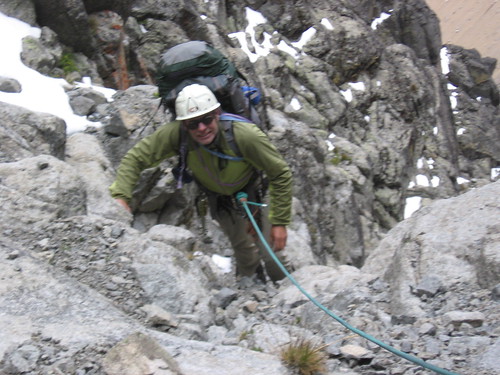
The next day we slept in a bit, then continued up the steep trail toward the Barranco Camp. The excitement came when the trail stopped at a rock wall. A short 4th class scramble up the wall and we were off. The porters with huge bags on their heads carefully scaled the rockiness. We stopped for lunch a short way from the camp, and followed it with an hour nap in the warm sun. Liking Kilimanjaro so far! We had arrived at camp much earlier than most people, and spent the afternoon reading and relaxing in the tent. "Mambo VP, Dada" said Stanley as he served us our hot morning tea in the tent vestibule. "Ready for breakfast, Caca?" (Team Rasta had begun calling each other Dada and Caca, which means sister and brother respectively). We had a leisurely breakfast and were last of the groups to leave camp. We were the first group to arrive at the next camp, Karanga Valley camp, 4000m. To get there we had to walk up "the wall", which was a steep lava rock ridge. Along the way we met a group of Italians, Team Italy, and I really enjoyed talking with Gretchen, the woman of the group (have not had a lot of contact with other women on this trip :). At Karanga Valley camp, we watched a truly Kilimanjaro sight... a group of porters arrive and set up a huge, heavy tent, tall enough to stand in. Then set up a table and chairs inside. Pretty soon a group of about 5 hikers show up, eat lunch in the tent, then continue on up the trail. The porters clean up, collapse the table and chairs, take the tent down, and put it all on their heads and walk on up the trail. All that just for the group to have lunch!! Crazy!

The next day we continued at lightning speed to Barafu Camp (4600 m). This is the high camp. We enjoyed the great views of Mt Meru (4566 m) along the way, and drank water until we could take no more at the last creek before the camp, as there is no more water available above it. At Barafu camp, we had most of the day to kill, so all of Team Rasta took naps. Some of the other porters when arriving at the camp, were jealous that their colleagues got to rest so much, so walked around our tents yelling "Wake up Rasta!". We had an early dinner so that we could get a full night's sleep in before the summit attempt the next morning.

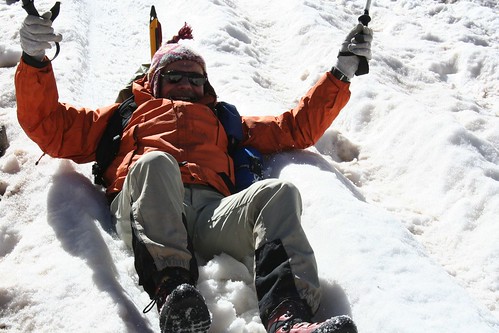
Stanly brought us hot tea and peanut butter and hunny sandwiches at 1:45 am, the night of Solstice. We left camp at 2:30 with Jerald and one of the porters. We were the last group to leave the camp, and enjoyed seeing the ribbon of headlamps bobbing up the mountain in front of us. About half way to the Stella point, the porter with us turned around, our pace was killing him. We passed everyone on the way up, hung out at Stella point (5680 m) until we were just too cold to stay, and were on the summit before sunrise at 6:00. We stood at the summit to watch the sun rise. What an amazing view. The crater's rings and glacier ice of Kilimanjaro with a Solstice sunrise raying gold and orange. It was cold though, otherwise i would have wanted to stay there all day! But, we headed down... Got in some good gravel foot glissade above Barafu, packed up our stuff, had second breakfast, and continued down toward Mweka Camp at 3100 m. This was a 10,000 ft decent! With knees aching, we stopped about 2 hours before Mweka at a hut where they were selling beer. We rested, imbibed, then continued "pole, pole" ("slowly, slowly") downward.

When we finally arrived at Mweka, were were beat. While eating dinner, we saw Team Poland arrive at the camp. They summitted, but they looked exhausted and not very happy. The following day, we walked the last decent through the forest to the Mweka Gate/Village. We talked with a father and his two sons from Reno (Team Reno) on the way down; they ski at Squaw. Small world.

At the gate, we received our certificates saying we climbed Kilimanjaro, and were picked up by Joshia. Team Rasta drove into town and ate one last meal together (ugali (corn meal mush), goat meat, greens, and beer), before they dropped us off at our hotel in Arusha.

"Summer Solstice is active: it's about doing and expanding, living the dream envisioned in the dreamtime of Winter"... Thank you Kilimanjaro! And thank you Team Rasta!

Friday, June 8, 2007

Mt Kenya

Mt Kenya: 6/8-14/07
Kenya

We arrived in Nairobi at 4:00 in the morning and were immediately accosted by tour operators and scam artists. We took a nap at the hotel, and when we walked back into the lobby, they were waiting for us! We couldn't get away! Finally we shook everyone off and began looking for transportation to Mt. Kenya, our first mountain in East Africa. That is when we met Josiah, he was a nice, honest, and capable guy to organize our logistics.
Mt Kenya is a 5199m rocky mountain with two peaks, Nelion and Batian. Around the base of the mountain are 12 glaciers, but the one we saw, was small and getting smaller every day. It is well known that the glaciers on Kilimanjaro are disappearing, but the more immediate tragedy are the glaciers on Mt Kenya. Throughout history, many of the tribes around Mt Kenya held this rocky ice covered spire as sacred. The Kikuyu people deified it and still believe it's the seat of their supreme god Ngai. Some say it is the mystical source of the sacred Nile. Both summits are technical climbs, and Batian is best done in June and July, when Nelion is covered with Ice. We decided to climb the Batian North Face Standard Route, a 22 pitch rock climb with an overnight bivy about half way up.

Josiah hooked us up with transportation to the Sirimon Gate of Mt Kenya National Park, stopping for lunch in Nanyuki. From there we decided to take a chance hiking through the forest to the Moses hut that afternoon, instead of doing it in the morning as planned. It can be dangerous to hike the forest late in the day because of the elephants. When we asked what we should do if we see an elephant, they said, "well, elephants are afraid of smoke, so you can light a fire in the road." Yeah, right, an elephant is about to charge us and we just light a fire real quickly... "OK. What else can we do if we encounter an elephant?" They told us that elephants are very near sighted, so we will see them first... "So, drop your bags and run. Run downhill because elephants are slower going down." So with this great advice, and our 50+ pound backpacks full of climbing gear, we set out through the forest yelling "Hey Elephant!" every minute or two, and singing the Elephant Song (which we just composed!).

"we are Friends Of Elephant
Shelly and Rod are F.O.E.s
elephants are nice
elephants are beautiful
elephants have big ears
and elephants are wise
Elephants!
Elephants!
we are Friends of Elephant
letting our presence be known"

We made it to the Moses hut before dark, and just after a group of ~25 middle school kids on an end of the year field trip. They were so loud! These kids operated at volume 11 all through dinner, continuing until their teachers finally shut them up at 2 or 3 in the morning. Rod and I slept in our tent outside, but could still hear the giggles and screams well into the night.

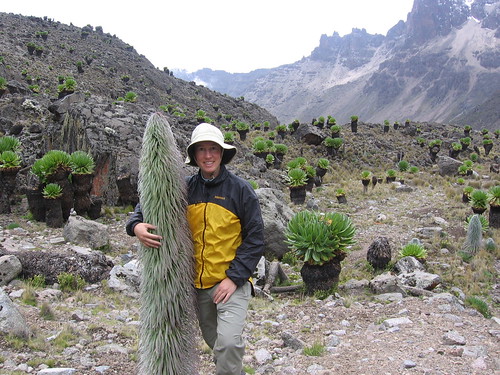
The next morning, we reluctantly slugged our enormous packs (Rod’s was 62 lbs) onto our backs and started the grueling 19 km hike to the Shiptons Hut (4200m). As we walked up the long valley toward the distant peak, the scrub vegetation changed into a woodland of odd Joshua tree-like plants, and 'Cousin It' relatives.
With the rocky summit of Mt Kenya appearing through the clouds periodically, we trudged through this otherworldly alpine flora and felt like we were entering a mystical land.

Once at Shipton, we set up camp and went inside the hut to make some dinner. The kids were there again, and louder than ever. We hoped the long hike would tire them out, but no such luck. We made onion soup with spaghetti, and drank hot sugary milk. Tomorrow we will take a rest day and prepare for the climb.

We spent the morning napping and reading and chasing the cute curious Hyrax. These little marmot-like animals are the closest living relative to the elephant! Go figure. Then we walked up to the base of the climb to check out our route. The group of kids hiked up to Point Lenana, the highest point you can hike to. We thought for sure they would be quiet tonight, but no! Loud and boisterous as ever.

In the morning we woke early and headed to the climb.
Our packs were heavy because we had a full climbing rack and gear to bivy overnight (bivy sacks, sleeping pads, sleeping bags, water, food, some warm clothes). The first pitch was slow as we got used to climbing with the extra weight, but the second and third were faster.

When we got to the prominent corner, that leads to a slab traverse that will take us to 'the amphitheatre' (where we bivy), we were behind schedule. And then, the clouds started to move in; icy cold wind and quickly closing visibility. We were tired from climbing with the overnight gear, moving more slowly that we wanted, and it sure looked like something big was rolling in. Within 15 minutes, it started to snow. We reluctantly decided to turn around. We rappelled off and were shaking uncontrollably from the cold by the time we reached the ground. Good thing we turned around too, because it wasn't just an afternoon thunder storm, it snowed all night and put down about 5 inches. If we had continued climbing, we would have had a freezing night, and a climb covered with snow and ice in the morning. The next morning a rescue helicopter was circling the mountain. I guess another climbing team, on a different route, got stuck up there.

Well, this is another mountain I definitely want to come back to. Perhaps in the winter to climb the Nelion route. It is shorter and doesn't require the overnight bivy. And the weather is supposed to be more stable at that time. Regardless, the experience was great. And still, as my friend Paul said, "getting stormed off a 22 pitch climb in Africa is pretty cool."

The next day we hiked to the Mintos Hut and set up camp. All around this camp sight are beautiful lakes that look over the cliff edge of the Gorges Valley. In the morning we set out for the Chogoria gate. This decent was absolutely beautiful and varied. We started in the funky alpine flora, into grasslands, through bamboo, and into jungly wetlands. We saw (smelled first) a waterbuck (Kobus ellipsiprymnus) as we entered the wetlands, and were careful about surprising the Buffalo as we crossed it. We made it to the Bantas in the late afternoon. We got a cabin, enjoyed a HOT shower, and even acquired beer with dinner!
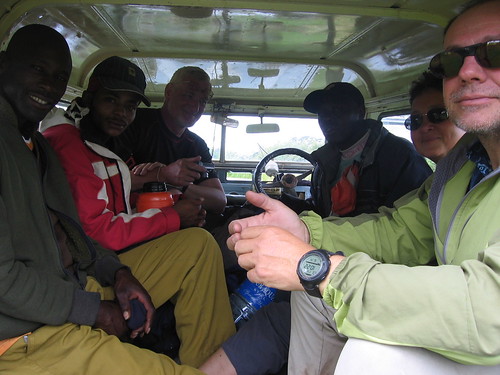
Josiah met us there the next morning, arriving in a Land Rover to get us over the muddy jungle road and to Chogoria town. The Land Rover filled up with folks heading to town, including one riding with the bags on the roof.
Mt Kenya. Outstandingly beautiful. And the god Ngai sent us away with the mission of visiting this place again.

Saturday, June 2, 2007

Mt Zion & Temple Mount

Mt Zion: 6/2/07, Temple Mount: 6/3/07
Jerusalem

... coming soon ...

Wednesday, May 30, 2007

Mt Sinai

Mt Sinai: 5/30/07
Egypt

Of course this expedition would not be complete without a journey up, arguably, the most famous sacred mountain in the world. Rising up out of the dry sands of the Sinai desert, higher than the other rocky peaks surrounding it, is the towering Mt Sinai (2285m). İt is locally known as Gebel Musa. Although disputed by archaeologists and historians as the exact place, Christians, Muslims, and Jews all believe that God presented his Ten Commandments to Moses on its summit; a place profoundly sacred to all the world's major monotheistic religions.

To get there we got tickets for the "Fast Boat" ferry from Aqaba, Jordan to Nuweiba, Egypt. Boy, that was not true! The "Fast Boat" supposedly left at 11am and took 1.5 hours (we will get there by 1 at the latest, we thought). We didn't even board until noon, we sat at the dock until 3, and we got there at 5:30. It was complete unorganized chaos... and they do the same trip every day... you would think they would have it downpat?!. At the port in Egypt we hired a taxi, driven by a Bedouin who had two wives (Rod was very interested in talking about that!), to take us to Saint Katherine's, a town deep in the Sinai desert.
We ate dinner with our driver at a Bedouin restaurant, then were dropped off at the road to St Katherine's Monastery. Situated right at the base of Mt Sinai, this monastery has been in continuous operation since AD 330. İt is believed to be built beside the burning bush from which God spoke to Moses. It is one of the oldest continually functioning monastic communities in the world, and its chapel is one of early Christianity's only surviving churches. Because it has never been raided or sacked, İt is filled with an amazing collection of artwork and theological writings compiled over centuries. To get to the monastery, we had to pass through an armed police checkpoint, and walk with bags in hand 1 km up the dirt road, to its entrance.
When checking into the St Katherine's Monastery Guesthouse, we asked about the route up to the summit. The monk suggested we take the "Camel Route". Everyone takes the Camel Route. Looking at the map, I saw another, more direct route up and asked about it. "That," he said, "ıs The 3750 Steps of Repentance. It is very difficult." Turns out this trail (staircase really) was laid by one monk as a form of penance. He must have been really bad, because that was some serious work!

We got up at 2AM and walked through the shadows inside the monastery walls toward the beginning of the 3750 steps. After shaking off the enterprising Bedouin guides, we started up the ancient steps. They quickly led up a narrow rock walled gorge, twisting and climbing through small patches of sweet smelling pennyroil and sage. The gorge just got more and more beautiful. Sometimes we would get up onto a wide ledge and see the other rocky peaks, silhouetted with stars, over the gorge walls. We passed a chapel part way, and later through two narrow freestanding stone arches. Something about the narrow steep path, the sweet smelling darkness, and passing through these old doorways, really made the act of climbing Sinai feel like a sacred journey. The path almost glowed with the power of over 1500 years of people making this pilgrimage.

We stepped through the second stone arch and reached a small plateau under the summit. There were two stone chapels, a light wind rustling through an old tree, and a quiet monk selling hot tea. We were one of only two groups of people who took the 3750 steps up. Everyone else took the camel trail, and we were stunned to see how many lights zig-zaged up the last few switchbacks to the summit. It was like a torchlight parade! With the skies windy and hinting of rain, we sat with the monk and enjoyed some sweet tea and simple conversation while watching the lights. So glad we came up this way and not up the boring route with the noisy throng of tourists. And it is not true, this route is not difficult or hard to navigate. It is really the only way to experience this mountain!

After tea we joined the masses heading up the final stretch to the summit. İt was still before dawn when we arrived, so Rod and İ found a wind sheltered spot between some rocks to sit and wait. While sitting there, we suddenly realized that we both forgot our first wedding anniversary! Oh, that is bad! But we also realized that it doesn't really matter that the day isn't exactly right, as far as we are concerned we are celebrating our anniversary by watching the sun rise from the summit of Mt Sinai. And instead of a romantic dinner with a bottle of sparkling wine or something, we would get a celebratory cup of hot tea to sip together on the way down.

After the sun rose, we got to see the magnificent magical views all around us. The rich colors, interesting rock shapes and textures, and misty skies over the Sinai desert are just gorgeous. We gave our offering of water and started the walk down. We were sipping hot anniversary tea while walking down when a Bedouin camel jockey offered us camel rides. How could we pass that up?! He led us to his animals, and after scaryly standing up, we began a very painful and funny journey down the camel trail. The way they have the saddles; a big wooden post is cramming into your crotch as you ride! The gangly awkwardly moving camels clomp heavily down the rocky trail, and the jockey doesn't give any instruction on how to ride comfortably. Ouch!
Back at the monastery, with aches in all the wrong places, we ate some breakfast, then found our driver to head back to the ferry and Jordan.

Monday, May 28, 2007

Mt Jebel Tannur

Jebel Tannur: 5/28/07
Jordan

"We must have passed it."
"OK. I'll turn around, but I didn't see anything... and Ι was looking."
"It has got to be around here somewhere. Hey, look at that mountain, it looks like it is separated from all the others, unique... maybe it's that one?"

This is our conversation as we drive up and down Jordans Wadi Hesa valley searching for the elusive Jebel Tannur. Atop this mountain, if we ever find it, are the ruins of the Khirbet et-Tannur Nabatean temple. The Nabatean people were traders who flourished in southern Jordan and northern Arabia from about 500 BC to 50 BC. They traded goods and culture with the Egyptians, Greeks, and other cultures of the day, until the Romans ended things.

The Nabatean culture is important to this expedition because they worshiped mountains. Their temples, places of worship and sacrifice, were on the top of mountains. The archaeologist, Philip Hammond, comments that: “the god of the people was Dushares, 'Lord (dhu) of the Shara (Mountains)'. They had a mountain god... people of my own heart. Their major female deity was Al-Uzza, who was usually represented as a lion. Their major male deity was AlQaum, a warrior god, who was associated with the bull.

"I think i saw something! Turn around again."
"Yeah, that old rusted sign, i think i can read the word 'Tannur'."
"This is it!"

We turn off the paved road onto a gravel track skirting a small hill and head strait toward the one mountain that seemed individual in the area. When we park, we are passed by a Bedouin boy and his goats, walkiıng from his tent/house to pasture... İ cant imagine where. He looks at us like he can't imagine what we are doing there. We grab some water and start walking along the animal trails up the side of the mountain. Not really believing that we will find anything, we reach the summit and see the pillar bases and carved blocks of an ancient temple. The temple basically takes up the entire summit of this peak... we can only imagine how grand and impressive it was when it was standing. Rows of pillar bases surround a raised platform and altar. Much of the ground is flat, paved with rock squares. There are round fallen pillar pieces, carved roof blocks, and stones with engraved writing everywhere! Amazing! From the bottom you would never know this is up here!

We explore and admire for quite a while. Then head back down to the car and down the valley toward the southern coast of Jordan. Along the way we find another Nabatean ruin, Khirbet --ναμε---. Οη μαν, νος τηε αλπηαβετ ηασ βεψομε γρεεκ. ςηατ αμ ι σθπποσεδ το δο_ Ι δοντ κνος ηος το σςιτψη ιτ βαψκ!

Sunday, May 27, 2007

Mt Nebo

Mt Nebo: 5/27/07
Jordan

Following the twists of the road to the top of Mt Nebo, goats wander through the dry rocky landscape, tent homes of the Bedouin are scattered in the swirling dust, and huge machine guns are mounted to the top of hummers parked at the road's check points.

We are in the Holy Land. We are following the route Moses was forbidden to travel by the King Edom (Numbers 20), and headed to the spot where Moses was given a view of the Promised Land (Deuteronomy 34:1) and where Moses was later buried, by the Hebrew God himself. The episode of Balak and Balam (2:13-26) also took place here.

From the top (817 m, 2680 ft) is a panoramic view of the "holy land", including the River Jordan, the Dead Sea, and the Palestinian West Bank. They say that the cities of Jericho and Jerusalem are visible on a clear day (which is not surprising because they are just on the other side of the valley), but alas, it is not a clear day.

We walk up the stone pathway and into the courtyard of the Byzantine chapel at the summit. The chapel was originally built in the 4th century AD, and is now a mix of museum and peaceful sanctuary. The whole place has an easy, holy, peaceful feel. An olive tree outside, one among many, was planted by the Catholic Pope John Paul II, to promote peace between the Muslim and Christian people. The inside is a simple stone walled chapel and alter, flanked by beautiful, nicely preserved tile mosaics depicting animals and various christian stories. Outside is a very interesting sculpture of a cross with a serpent twisted around it.

As we look out over the valley of the River Jordan, I am struck by the power that the legends of this place have, and have had, over people. Wars and wars and wars have been fought over mere details pertaining to this place. I think about this as i meditate and make my offering of water to the mountain. When i pour the water out of the bowl, something happens that has not happened anywhere yet, one of the stones falls out of the bowl! I am not surprised when i realize that the stone that fell out is Rose Quartz. Rose Quarts, the stone of love. It opens up the heart for both giving and receiving love. It brings gentleness, forgiveness, compassion, kindness and tolerance. More of that is exactly what this place needs.

Soaking our feet in the altra super salty water of the Dead Sea.

Friday, May 18, 2007

Mt Atlas

Mt. Atlas (Jebel Toubkal), Morocco : 5/18-19/2007
IMG_1300
I take a sip of hot, sweet, strong mint tea. Rod and the taxi driver are looking at our topo map of Jebel Toubkal as another young man points out the trail and route. We have just arrived after a two hour drive from Marrakesh, and are waiting for our lunch sandwiches (egg with fried onion and tomato in flat bread) to be made before we start our hike. The air is clear and hot, but the sad, desperate screams of two goats, who are laying on the ground, legs tied, awaiting slaughter, are making me uneasy. What does Atlas have in store for us?

A long time ago, Gaia and Uranus had 12 children. Known as the 12 Titans, these are the parents, aunts, and uncles of the Olympian Gods. The Titans Cronus and Rhea are the parents of Zeus, and Titans Lapetus and Clymene are the parents of Atlas. So, Atlas and Zeus are cousins. The Titan Cronus ruled the gods, but Cronus was getting old, too old. His son, Zeus, wanted to rule the gods, so set out to fight Cronus and take the throne. He organized his brothers and sisters into an army against their father. Atlas, in defence of Cronus, organized an army too, and they fought a battle for 10 years. Needless to say, Zeus' forces won. Zeus banished all those who fought against him to Tartarus (where they remain), but since Atlas led the opposition, he was punished more severely. He was sent to the farthest western corner of the world, where the sun sets, and there he must hold up the heavens on his shoulders for eternity.

The air is heavy as we set out from the village of Imlil, up the Mizane river valley, toward the climbers refuge where we will spend the night. The high Atlas mountains are beautiful, rugged, and brown, scattered with brilliant green oasis of palm trees or small irrigated plots of wheat or nut trees. We walk with full packs up the dusty trail, getting passed by horses loaded with the backpacks of other hikers, and then by the hikers themselves. At one point, we pass two Berber girls, selling bottles of soda cooled in a small waterfall. They decide to taunt Rod, yelling in Berber and gesturing to him that because he has a necklace on, he must be gay... or a dog... we aren't exactly sure. We stop in a little village for a cup of mint tea where the trail crosses the river. Later, tired and hungry, we finally see the climbers refuge in the distance. As we walk up the valley toward it, a cold wind picks up and we get basted with some icy rain.

A long time ago, Hercules walked up the valley toward where Atlas and his wife Phoebe had their home and garden. Hercules was completing the 'Twelve Labors' required of him if was to escape enslavement and become immortal. One task was to get a golden apple. In the orchard at Atlas' house was the golden tree, guarded by a fierce dragon, that bore golden apples. Hercules approached Atlas as he stood holding the heavens on the ridge top, and asked for a golden apple. Atlas thought his release had finally come! He said to Hercules, "Sure, you can have an apple. I can go get it for you from my orchard, the dragon cannot hurt me. If you just hold this burden for me, i will go get the apple." So Hercules took the heavens onto his shoulders. Atlas thought he was very clever for tricking Hercules. Atlas was free! That dumb lump could hold the heavens for eternity! So Atlas went to the garden and got an apple and brought it up to where Hercules was, like he said he would. Because Hercules could not take the apple into his hands, Atlas put the apple on the ground and thinking he was so slick, started to walk away. Hercules, thinking quickly said, "Oh how could i have been so tricked! Now i have to hold the heavens on my shoulders forever! Whew, this is really uncomfortable! If i just had a pad to put between my shoulders and the heavens, it might be more bearable..."
Atlas turned and looked back.
"Atlas, you have tricked me! You could at least give me a pillow!"
So Atlas, being kind, but not the brightest Titan, went and got a pillow for Hercules. When he brought it, Hercules asked him if he could just hold the heavens for a second, while he got the pillow situated. So Atlas took the heavens, and Hercules, laughing, grabbed the golden apple off the ground and ran off.

"Salam."
"Salam aleikum" the refuge keeper replies as we approach the door. "Take your shoes off."
We put our dusty, stinky boots on a shelf by the door and enter the large refuge. This is the biggest refuge we have seen yet, it sleeps 80 people, and has two dining rooms. The French Alpine Club built and manages the refuge, while local Berber men work there. There were many other climbers at the refuge, all resting and getting ready to climb tomorrow morning. A amiable chatter filled the room with the fireplace as evening set in. Unfortunately, the friendliness, of the keeper at the door did not extend to all the staff. One man in particular was openly hostile to us. I don't know why this was exactly (except that we were not either Moroccan or French), and it was not a common occurrence in Morocco, but the experience certainly discolored our moods as we prepared dinner and settled into our beds that night.

A long time ago, Atlas' wife, Phoebe brought the golden tree that bore golden fruit to their orchard. And Atlas was told a prophecy, that one of the sons of his enemy Zeus would come to steal the golden tree from him. Atlas, understandably, was not very keen on the family of Zeus having his best treasure. So one day, as Atlas was kickin' it high on the ridge with the heavens on his shoulders, Perseus, son of Zeus, arrived. Now, Perseus was not out to steal Atlas' tree, he was just really tired and hungry and in need of a place to stay... after all, he had just fought and beheaded Medusa. Atlas, thinking this was the thief of the oracle, refused him. Perseus was irritable, being tired and hungry, and got really mad at Atlas. He grabbed Medusa's head from his bag, and averting his eyes, he held it up to Atlas. When Atlas looked at it, he turned into stone... the stone that is Mt Atlas. And upon the shoulders of this mountain, all the stars and the heavens are held.

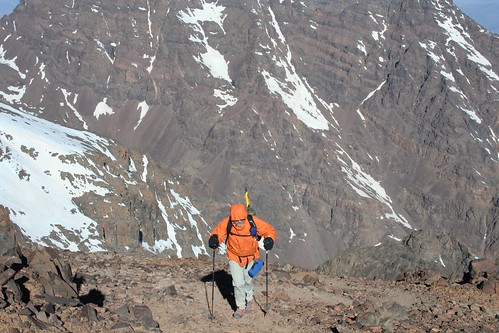
With so many people at the refuge, and heading out tomorrow to climb, we decide that we will get up extra early (3:30 am) to assure a pleasant climb with no other people around. We quietly prepare breakfast, and slip out before anyone else is up. Under the stars, we follow the route across the small river, and up the steep narrow valley directly east of the refuge. The icy wind is blowing (!), and the gusts make us stumble as we climb. Soon, we are walking up firm snow fields, and the sun rises as we crest the first moraine and see the summit in front of us. The wind up here is even worse! My fingers are painfully numb with the cold, and we bundle up with everything we have as we reach the top of the second moraine. Here, while trying to maintain balance as the wind gusts, we have the choice to either follow the normal route up the south ridge, or skirt around the large bowl under the summit and climb the north ridge. It is funny because the staff in the refuge last night insisted that there is only one possible route up to the summit, only one! And we can see two easy ones just up this side... there must be hundreds of ways to summit this non-technical peak.

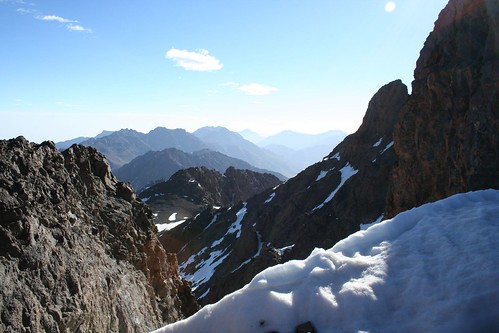
We stash our crampons at the top of the snowfield, and begin the loose talus and gravel slog up to the ridge top. From the top of the ridge, we see the first of the other climbers coming up over the last moraine below us. We walk along the ridge top to the summit (4165 m), amazed by the beautiful views. To the east and west, more jagged peaks (the high Atlas mountains), to the north, faint mountaintops in Spain, to the south, the Sahara desert. We get to enjoy the summit in solitude, warming in the morning sun, as the brutal wind has died down. After a while, the onslaught of climbers begins. There must be 15 people on the summit when we leave, and we pass maybe 20 more climbing up as we descend. We decide to walk the south ridge down, to make a loop of it. The decent is fast because most of the snow fields have softened up, and we can have fun with sitting glissades.

Back at the refuge, we pack up our stuff and have some lunch. Then we begin the dusty walk down. As a man with horses passes us, Rod asks him if his animals can carry our packs. Relieved of our burdens, we walk more happily down, stopping for tea, and playing word and number games as we walk. In the village, our taxi driver is waiting for us, turns out, he came 2 hours early. We have one more cup of sweet mint tea and begin the drive back to Marrakesh. As we pass through the agricultural valley at the foot of the mountain, nice old Atlas gives us one last gift... in his orchard, we see a flock of nesting storks!